



Application Prospects of Polyetheramine Fuel Additives
I. Introduction
Polyetheramine (PEA) represents a novel class of fuel additives featuring both polyether segments and amine functional groups within their molecular structure. Its general structural formula can be represented as R-O-(CH2CH2O)_n-(CH2)m-NH2 (where R denotes alkyl/aryl groups, and n, m represent degree-of-polymerization control parameters). This structure confers unique amphiphilic properties to PEA: the lipophilicity of the polyether segments ensures excellent solubility in fuels, while the polarity of the amine groups (particularly primary/secondary amines) provides strong adsorption and reactivity. Simultaneously, PEA contains no metallic elements, resulting in low ash residue after combustion. Its high nitrogen content in the amine group (typically 5%–12%) enables pyrolysis to generate nitrogen-containing active species, delivering multifunctional benefits including detergency, oxidation resistance, and combustion enhancement.
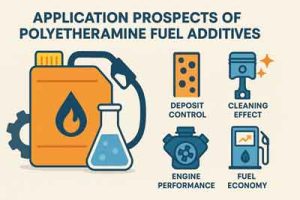
Traditional fuel additives (such as polyisobutylene amine and Mannich base) struggle to meet stringent requirements for low emissions and high compatibility. PEA, with its strong structural design flexibility and outstanding environmental friendliness, has emerged as a core direction in fuel additive technology iteration. Its application potential in gasoline, diesel, marine fuels, and Sustainable Aviation Fuel (SAF) is gaining significant attention, offering new technical pathways for efficient engine operation and pollutant reduction.
II. Performance Advantages
PEA’s core performance advantages stem from its molecular structure’s synergistic adaptability to fuel systems and engine operating conditions, manifested in four key aspects:
Low-Temperature Dispersancy: The polyether segments in PEA molecules suppress the aggregation and sedimentation of gum and wax particles in fuel through steric hindrance effects. Meanwhile, the amine groups adsorb onto particle surfaces via hydrogen bonding, reducing interfacial tension. This stabilizes deposits as nanoscale dispersed phases within the fuel, effectively preventing fuel line and filter blockages at low temperatures—making it particularly suitable for fuel systems in frigid regions.
High-Temperature Oxidation Resistance: Under engine high-temperature conditions (200–400°C), the amine groups in PEA capture free radicals (e.g., ·OH, ·OOH) generated by fuel oxidation, terminating oxidative chain reactions and inhibiting the formation of harmful substances like peroxides and aldehydes/ketones. Simultaneously, the thermal stability of the polyether chain segments reduces additive self-decomposition, extending fuel shelf life and engine service life.
In-Cylinder Cleaning Performance: PEA delivers dual “cleaning + anti-deposits” efficacy against carbon deposits on engine combustion chambers, injectors, and intake valve surfaces. The alkalinity of the amine group neutralizes acidic sites on carbon deposits, disrupting their adsorption to metal surfaces. The polyether chain dissolves oily carbon deposits while forming a dense adsorption film on metal surfaces, preventing the deposition of fuel cracking products. This optimizes combustion efficiency and reduces particulate matter (PM) and nitrogen oxides (NOₓ) emissions.
Renewable Component Compatibility: Compared to conventional additives, PEA exhibits excellent compatibility with renewable fuel components such as biodiesel, ethanol gasoline, and Sustainable Aviation Fuel (SAF). Its amphiphilic structure mitigates the high viscosity and water absorption issues of renewable fuels like biodiesel, enhancing blended fuel stability. Simultaneously, the presence of amine nitrogen compensates for the low combustion efficiency caused by insufficient nitrogen content in biofuels, driving the large-scale adoption of renewable fuels.
III. Application Scenarios
3.1 Gasoline Cleaner (GDI/PFI)
In gasoline engines, carbon buildup issues differ significantly between direct injection (GDI) and port injection (PFI) engines. PEA can be specifically tailored to meet the needs of both engine types.
For GDI engines, PEA effectively cleans carbon deposits on the injector nozzle tip and combustion chamber walls. This resolves issues like poor fuel atomization and delayed ignition caused by deposits, improving fuel economy by 3%–8%.
For PFI engines, its strong dispersing properties prevent intake valve carbon buildup. This avoids power loss due to valve seal leakage while meeting stringent National VI emission standards for particulate number (PN). PEA is the core active ingredient in current high-end gasoline detergents.
3.2 Diesel Ignition Enhancers
Diesel engines’ compression ignition characteristics demand high fuel ignition performance. PEA generates nitrogen-containing active species (e.g., NH3, CN・) through amine thermal decomposition, lowering diesel auto-ignition temperature (by approx. 5–10°C). This shortens ignition delay time and improves cold start performance.
Additionally, PEA inhibits the polymerization of soot precursors (polycyclic aromatic hydrocarbons) formed during high-temperature diesel cracking. This reduces carbon deposits on piston tops and exhaust manifolds. It is particularly suitable for high-pressure common-rail diesel engines, enabling simultaneous reductions of 5%–12% in NOx and soot emissions.
3.3 Very Low Sulfur Fuel Oil (VLSFO)
Very Low Sulfur Fuel Oil (VLSFO, sulfur content ≤0.5%) exhibits reduced lubricity and stability due to desulfurization processes. This can cause wear in marine engine fuel systems and clogging from deposits. PEA forms a lubricating protective film through chemical adsorption of its amine groups onto metal surfaces. This enhances boundary lubrication properties, reducing wear rates in injection systems. Simultaneously, its dispersancy inhibits the flocculation and sedimentation of asphaltenes in low-sulfur fuel, preventing fuel filter blockages and injector sticking. This ensures reliable performance during extended voyages.
3.4 Aviation SAF / Biodiesel
Sustainable Aviation Fuel (SAF) and biodiesel, as low-carbon alternative fuels, face technical challenges such as poor low-temperature flowability and insufficient oxidation stability. PEA serves as a multifunctional additive. It improves SAF’s low-temperature pumpability (lowering the cold filter plugging point by 3–6°C) while inhibiting oxidation and rancidity of unsaturated fatty acid esters in biodiesel. It extends fuel storage lifespans. Furthermore, its low ash combustion characteristics prevent turbine blade fouling. Meeting aviation fuel’s stringent additive safety requirements, it provides technical support for aviation carbon reduction.
IV. Technical Bottlenecks
Despite PEA’s significant advantages, its industrial application currently faces three core technical challenges:
High synthesis costs. Traditional PEA production relies on a batch amination process using polyether polyols and amine compounds. This process demands harsh reaction conditions (high temperature and pressure, large catalyst consumption) and yields low-purity products (requiring multi-step purification). Consequently, unit costs are 30%–50% higher than conventional additives, limiting its adoption in mid-to-low-end fuel markets.
Risk of high-temperature decomposition. Under extreme engine conditions (e.g., localized piston top temperatures exceeding 450°C), the polyether segments in PEA are prone to thermal cracking. Generation of small organic molecules. This not only reduces additive efficacy but may also produce trace carbon deposit precursors, compromising combustion cleanliness. Simultaneously, high-temperature decomposition of amine groups may release NH₃. While this aids combustion, excessive emissions can deactivate exhaust aftertreatment systems (e.g., SCR catalysts).
The dosage window is narrow. PEA efficacy exhibits a pronounced nonlinear relationship with dosage: insufficient levels fail to achieve expected cleanliness and oxidation resistance, while excessive dosages (exceeding 1000 ppm) may cause abnormal fuel viscosity, incomplete combustion, or even engine knocking. Precise formulation tailored to different fuel systems (gasoline/diesel/SAF) is required, increasing application complexity.
V. Breakthrough Directions
To address the aforementioned bottlenecks, current technological R&D focuses on the following four major breakthrough pathways.
Continuous Catalytic Ammonolysis. Develop highly efficient supported catalysts (e.g., Cu-Ni/Al2O3). Construct continuous ammonolysis reaction units for polyether polyols and amines. Optimize reaction temperature, pressure, and residence time. Increase product yield from 75% in traditional processes to over 90%. Simultaneously reduce catalyst consumption and energy usage to lower synthesis costs.
Precision molecular tailoring. Achieve precise structural modification of PEA molecules by controlling polyether segment length (n=2–10), amine type (primary/secondary/tertiary amine), and linker structure (m=2–6). For instance, short polyether segments enhance low-temperature dispersibility, while tertiary amine modification improves high-temperature stability, targeting performance gaps in diverse application scenarios.
Nano-Hybrid Composite Modification. PEA is hybridized with nanoparticles (e.g., TiO2, graphene quantum dots). Leveraging the high specific surface area and catalytic activity of nanoparticles, this enhances PEA’s antioxidant efficiency and high-temperature stability. Simultaneously, the lubricating properties of nanoparticles further improve boundary lubrication effects in fuels. This expands multifunctional integrated characteristics.
AI-Assisted Formulation Optimization. Construct a correlation database linking PEA molecular structure, performance, and fuel systems based on machine learning algorithms. Simulate PEA efficacy under varying dosages and fuel components via high-throughput computational modeling to precisely predict optimal addition ratios and molecular structure parameters. This shortens formulation R&D cycles and addresses the challenge of narrow dosage windows.
VI. Conclusion
Polyethyleneamine (PEA), with its core amphiphilic, low-ash, and high-nitrogen structure, demonstrates irreplaceable advantages in fuel cleanliness, oxidation resistance, and combustion enhancement. It has become an ideal additive for multiple fuel systems including gasoline, diesel, marine low-sulfur fuel, and aviation SAF. Its application not only improves engine efficiency and reduces pollutant emissions but also drives the large-scale adaptation of renewable fuels.
Despite current technical bottlenecks such as high synthesis costs, insufficient high-temperature stability, and a narrow dosage window, breakthroughs in continuous catalytic synthesis, molecular precision design, nano-hybrid modification, and AI-driven formulation optimization will continuously upgrade PEA’s performance while gradually reducing costs.
Looking ahead, PEA is poised to become a core product in the fuel additive sector. It will serve as a technological bridge connecting cleaner fuels, more efficient engines, and low-carbon energy systems, playing a pivotal role in the green transformation of the transportation sector.